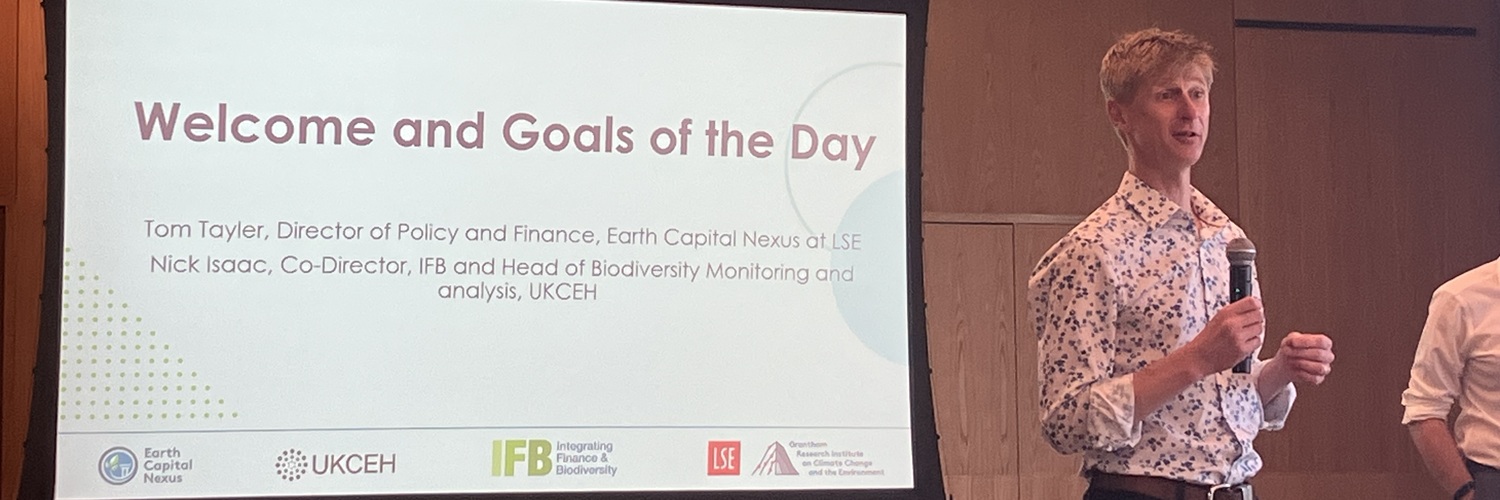
What if we treated nature as infrastructure? How could this approach strengthen the resilience of both the UK economy and the natural environment? And, how might it help unlock greater public and private investment in protecting and restoring the UK's critical natural assets, while redirecting capital away from activities that degrade them?
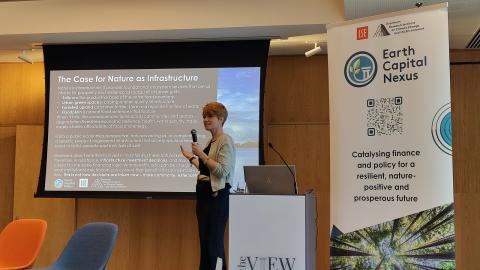
IFB Flagship Leader Professor Nicola Ranger delivering her keynote talk
These were the questions at the heart of a collaborative working session held during London Climate Action Week, organised by Earth Capital Nexus@LSE in partnership with the IFB and the UK Centre for Ecology & Hydrology.
Despite soaring temperatures, around 80 delegates attended the event, representing financial services organisations, academia and Defra's Nature Markets team. Bringing together expertise from across finance, policy and environmental science, the workshop explored how reframing nature as essential infrastructure could transform investment, decision-making and public policy.
Opening the session, IFB Programme Leader, Dr Nick Isaac, explained why the concept of nature as infrastructure has become increasingly important during his career as an ecologist.
"I've spent 25 years researching the state of nature, how it changes over time, and how those changes are driven by human activities. And, it has become increasingly apparent that the dependency goes both ways: human systems depend intrinsically on nature, and nature provides enormous benefits to our societies.
"Today we're exploring those connections by framing nature as infrastructure. When the benefits nature provides are disrupted, people, businesses and communities are affected. The challenge is to structure investment and incentives that move us out of this vicious cycle and into one where the value of nature is recognised in decision-making."
The event featured keynote presentations from Tony Goldner, Emma Howard Boyd CBE, and IFB Flagship Leader Professor Nicola Ranger, alongside practical workshops and breakout discussions designed to identify both the barriers and opportunities for change. Participants also heard from organisations already putting these ideas into practice, including Rebalance Earth, LENs Company and the Evenlode Landscape Recovery project.
A recurring theme throughout the day was that discussions around nature finance are becoming increasingly practical. While there was continued optimism that nature finance solutions are "ready to scale", delegates focused on the practical mechanisms needed to make that happen. There was growing clarity around which aspects of nature recovery could attract private investment and which would continue to require public funding.
Participants also highlighted the importance of establishing a clear and consistent regulatory framework capable of providing investors with confidence and appropriate risk-adjusted returns. Trusted organisations were recognised as having a vital role in building confidence, developing standards and bringing together partners across sectors.
The workshop also explored the power of language in shaping public and political engagement. While "nature as infrastructure" was seen as a compelling concept for policymakers and central government, some participants suggested that describing nature recovery as a "national upgrade" may resonate more strongly with the wider public.
Running through many of the discussions was a sense that the UK's changing political landscape presents a significant opportunity to embed these ideas into future policy and investment decisions. Delegates recognised that the change of government offers a window of opportunity to reshape how nature is valued—not simply as something to be protected, but as essential infrastructure that underpins economic resilience, public wellbeing and long-term prosperity.
As an initial step in what organisers hope will become a broader movement, the workshop sought to build momentum around new narratives for valuing nature while identifying practical pathways to increase investment in protecting and restoring the UK's critical natural systems.